<?xml version="1.0" encoding="utf-8"?><feed xmlns="http://www.w3.org/2005/Atom" ><generator uri="https://jekyllrb.com/" version="3.10.0">Jekyll</generator><link href="https://maneshgar.com/journal/feed.xml" rel="self" type="application/atom+xml" /><link href="https://maneshgar.com/" rel="alternate" type="text/html" /><updated>2026-11-15T15:05:01-08:00</updated><id>https://maneshgar.com/journal/feed.xml</id><title type="html">Behnam Maneshgar</title><subtitle>News, books, finance and notes on what I&apos;m learning, by Behnam Maneshgar.</subtitle><author><name>Behnam Maneshgar</name></author><entry><title type="html">Why I Stopped Expecting a Big Crash?</title><link href="https://maneshgar.com/journal/2026/why-i-stopped-expecting-a-crash/" rel="alternate" type="text/html" title="Why I Stopped Expecting a Big Crash?" /><published>2026-11-10T00:00:00-08:00</published><updated>2026-11-10T00:00:00-08:00</updated><id>https://maneshgar.com/journal/2026/why-i-stopped-expecting-a-crash</id><content type="html" xml:base="https://maneshgar.com/journal/2026/why-i-stopped-expecting-a-crash/"><![CDATA[<p>For the past six months, I expected a big crash to be just around the corner. We keep
hearing the same warnings: earnings are stretched, valuations are high, and the
S&amp;P 500 is more concentrated in a handful of big tech companies than ever. But
when I looked at the history, the picture looked quite different.</p>

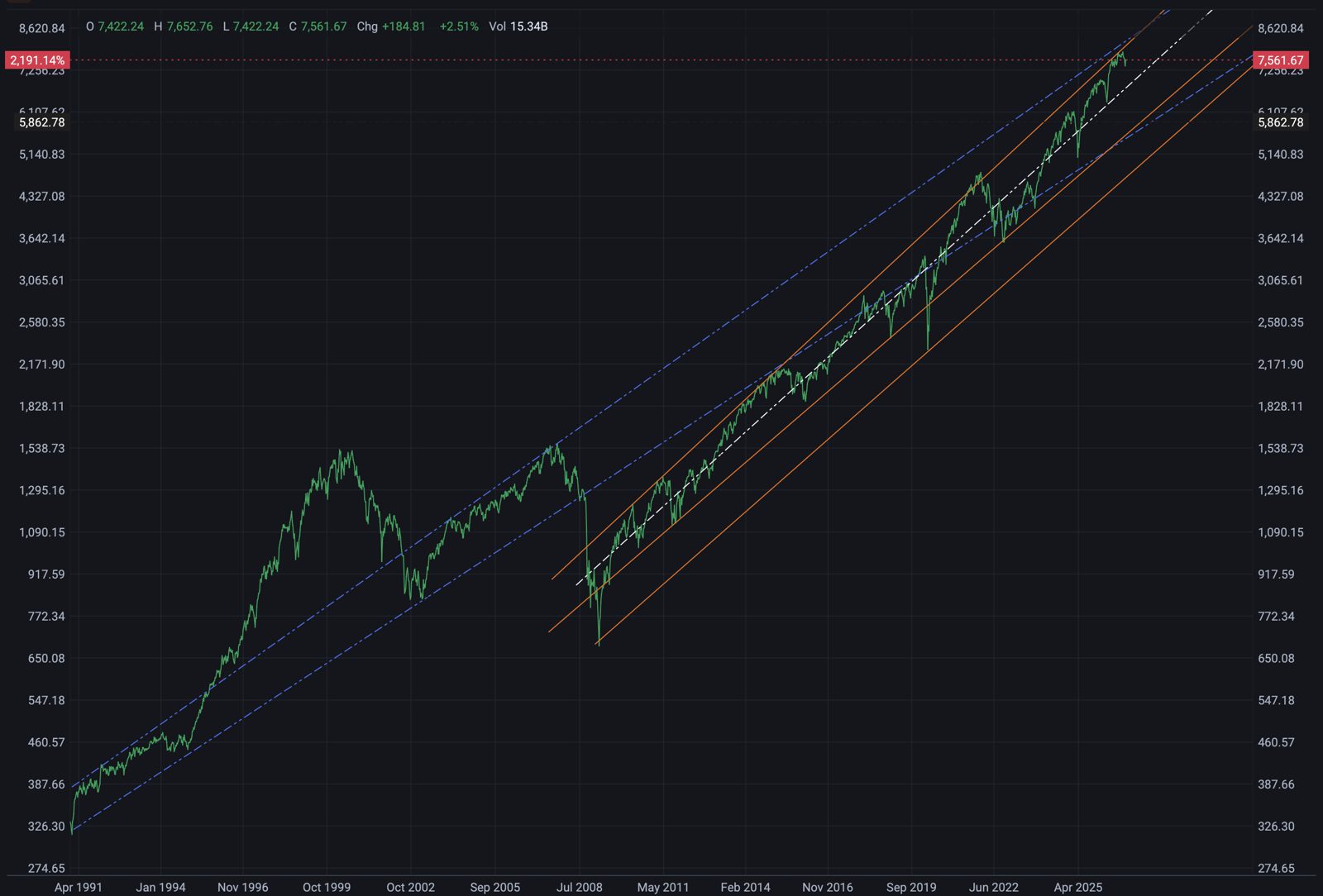
<p><img src="/images/journal/sp500-log-trend.jpg" alt="The S&amp;P 500 since 1991 on a log scale, with its long-term trend channels" /></p>

<p>The chart above is the S&amp;P 500 since 1991, on a <strong>log scale</strong>. That’s something
I learned only recently, and it changed how I look at markets. On a normal
chart, a 10% move at today’s levels looks enormous next to a 10% move in the
1990s. On a log scale, equal percentage moves look the same size, so you can
finally compare different decades fairly. And for long-term growth, the log
scale is really all that matters.</p>

<p>Seen this way, the market looks surprisingly <strong>linear</strong>. The blue lines show the
channel it followed from the early 1990s through 2008. The orange lines show the
channel it has followed since the 2009 low, with the white line through the
middle. Even the big drops, like 2008, 2020 and 2022, look like dips that the
index recovered from, returning to its trend instead of breaking it.</p>

<p>That gives me a simple way to think about bubbles. Instead of reacting to every
headline, I can check whether the market is still following its trendline. If
it’s running far above it, that’s a warning sign. If it’s moving along it, the
growth may be less of a bubble than it sounds.</p>

<h2 id="why-a-crash-is-unlikely">Why a crash is unlikely</h2>

<p>Because of these lines. Over the last three decades, the market has kept coming
back to its long-term trend, through recessions, crises and a pandemic. Today’s
level is still inside the channel, not breaking out far above it.</p>

<p>That said, we are on the <strong>higher side</strong> of the channel right now, close to its
upper edge. If the pattern holds, I’d expect the market to come down from here,
back toward the middle of the channel. To me, that looks more like a pullback
than a crash.</p>

<p>There’s another detail worth noticing: near today’s high, the <strong>orange and blue
lines meet</strong>. The faster channel since 2009 has caught up with the slower,
longer-term one. That could mean the market has been growing faster than its
long-run average, and that growth may slow down from here.</p>

<h2 id="why-a-crash-is-still-possible">Why a crash is still possible</h2>

<p>Because this chart doesn’t show what came before. It starts in 1991, and the
trend before that was very different. A pattern that held for thirty years is
not a law of nature, and markets have gone through long stretches where the
trend broke or flattened for years.</p>

<p>So I haven’t stopped believing a crash <em>can</em> happen. I’ve just stopped assuming
one is coming, simply because the headlines say so.</p>

<p>I’ll leave the rest of the analysis to you. Take a look at the chart and draw
your own lines.</p>

<p><em>This is my personal view, not financial advice.</em></p>]]></content><author><name>Behnam Maneshgar</name></author><category term="finance" /><summary type="html"><![CDATA[On a log scale, the S&P 500 looks a lot more linear than the headlines suggest. Here's what that tells me, and what it doesn't.]]></summary></entry><entry><title type="html">Lower the Risk, Then Raise It!</title><link href="https://maneshgar.com/journal/2026/lower-the-risk-then-raise-it/" rel="alternate" type="text/html" title="Lower the Risk, Then Raise It!" /><published>2026-10-28T00:00:00-07:00</published><updated>2026-10-28T00:00:00-07:00</updated><id>https://maneshgar.com/journal/2026/lower-the-risk-then-raise-it</id><content type="html" xml:base="https://maneshgar.com/journal/2026/lower-the-risk-then-raise-it/"><![CDATA[<p>When people ask me how to start investing, or how to invest for the long run, my
answer has become surprisingly simple: lower the risk first, then raise it.</p>

<p>We always hear that the way to lower risk is to diversify, and that’s true. The
easiest way to do it is to buy an <strong>index</strong>, like the S&amp;P 500 or the
Nasdaq-100, instead of picking individual stocks. With an index, you don’t need
to study companies, read their financial statements or understand their
products. You simply get the average of the market, and you stop worrying about
everything else. What used to be a hundred questions shrinks down to just one:
is the market in a good place right now, or a bad one? If it looks good, you
buy. If it looks bad and risky, you sell.</p>

<p>Of course, a good investor wants more than the average, and this is where the
second half comes in. Once you’ve made things simple, you can raise the risk
back up with a <strong>leveraged</strong> version of the same index, a fund designed to move
two or three times as much as the index each day. Here are some common ones:</p>

<table>
  <thead>
    <tr>
      <th>Index</th>
      <th>Regular</th>
      <th>2x bull</th>
      <th>3x bull</th>
    </tr>
  </thead>
  <tbody>
    <tr>
      <td>S&amp;P 500</td>
      <td>SPY, VOO</td>
      <td>SSO</td>
      <td>UPRO, SPXL</td>
    </tr>
    <tr>
      <td>Nasdaq-100</td>
      <td>QQQ</td>
      <td>QLD</td>
      <td>TQQQ</td>
    </tr>
    <tr>
      <td>Dow Jones</td>
      <td>DIA</td>
      <td>DDM</td>
      <td>UDOW</td>
    </tr>
    <tr>
      <td>Russell 2000</td>
      <td>IWM</td>
      <td>UWM</td>
      <td>TNA</td>
    </tr>
  </tbody>
</table>

<p>What I like about this approach is what it does to the problem. By buying the
index, you removed most of the variables from the equation and gave up some
performance in return. With leverage, you take that performance back. You end
up with a much simpler equation, fewer things to get right, and returns that can
still compete.</p>

<p class="w-caption"><img src="/images/journal/risk-basket.jpg" alt="A basket of eggs balanced against eggs spread out on a seesaw" class="w-shot-medium" />
<em>The idea: one leveraged basket of eggs weighs roughly the same as all the single eggs you’d pick by hand after a lot of effort. I tried to generate a clearer image that actually explains this, but AI tools aren’t quite there yet. At least not the free ones.</em></p>

<p>From there, the only real decision left is timing at a high level. When it feels
like a good time to be in the market, you stay in. When something starts to
smell off, you step out and put your money somewhere else until things look
better. That last part matters more than anything, because leveraged funds can
lose value in choppy, sideways markets, even when the index itself ends up flat,
and they fall much harder in a downturn. Knowing when to get out is what keeps
the strategy working.</p>

<p><em>This is my personal view, not financial advice.</em></p>]]></content><author><name>Behnam Maneshgar</name></author><category term="finance" /><summary type="html"><![CDATA[My favourite investing strategy for beginners and long-term investors: simplify with an index, then add the performance back with leverage.]]></summary><media:thumbnail xmlns:media="http://search.yahoo.com/mrss/" url="https://maneshgar.com/images/journal/risk-basket-thumb.jpg" /><media:content medium="image" url="https://maneshgar.com/images/journal/risk-basket-thumb.jpg" xmlns:media="http://search.yahoo.com/mrss/" /></entry><entry><title type="html">GeneExpert</title><link href="https://maneshgar.com/journal/2026/gene-expert/" rel="alternate" type="text/html" title="GeneExpert" /><published>2026-10-15T00:00:00-07:00</published><updated>2026-10-15T00:00:00-07:00</updated><id>https://maneshgar.com/journal/2026/gene-expert</id><content type="html" xml:base="https://maneshgar.com/journal/2026/gene-expert/"><![CDATA[<p><strong>GeneExpert</strong> is my first introduction to bioinformatics, and my first PhD project.</p>

<p>Bulk RNA-Seq is one of the most widely used ways to measure gene expression, in
both research and clinical settings. Yet while foundation models have
transformed how we learn from data like protein sequences, single-cell data and
medical images, bulk RNA-Seq has been left largely unexplored.</p>

<p>GeneExpert is our step toward closing that gap: a foundation model that learns
general-purpose representations of gene expression, capturing information about
both samples and genes. The goal is representations that are biologically
meaningful and useful across a wide range of biological and clinical
applications.</p>

<p>Alongside the model, we’re also building a way to systematically evaluate
foundation models for transcriptomics.</p>

<p>The results so far are very encouraging. More details will follow once the work
is published, so stay tuned!</p>]]></content><author><name>Behnam Maneshgar</name></author><category term="projects" /><category term="ai" /><summary type="html"><![CDATA[A foundation model for bulk RNA-Seq gene expression data. More to come once it's published.]]></summary><media:thumbnail xmlns:media="http://search.yahoo.com/mrss/" url="https://maneshgar.com/images/journal/geneexpert.png" /><media:content medium="image" url="https://maneshgar.com/images/journal/geneexpert.png" xmlns:media="http://search.yahoo.com/mrss/" /></entry><entry><title type="html">Start with Why</title><link href="https://maneshgar.com/journal/2026/start-with-why/" rel="alternate" type="text/html" title="Start with Why" /><published>2026-10-02T00:00:00-07:00</published><updated>2026-10-02T00:00:00-07:00</updated><id>https://maneshgar.com/journal/2026/start-with-why</id><content type="html" xml:base="https://maneshgar.com/journal/2026/start-with-why/"><![CDATA[<p><em>Start with Why</em> by Simon Sinek opens with an uncomfortable idea: we make
decisions based on what we <em>think</em> we know, and those assumptions aren’t always
true. Gathering more data doesn’t necessarily save us, especially when a flawed
assumption set the whole process in motion in the first place. One of my
favourite stories in the book makes the point. At an American car plant, workers
hammered every door into place with a rubber mallet to make sure it fit. At a
Japanese plant, there was no such step. “We make sure it fits when we design it,”
they explained, almost sheepishly. They didn’t study the problem and accumulate
data to find the best fix; they engineered the outcome they wanted from the very
beginning.</p>

<p>That, in short, is the book’s argument. Organizations and people who start with
<strong>why</strong>, their purpose, inspire us, while those who only talk about <em>what</em> they
do have to rely on manipulation instead. In the business-to-business world,
Sinek points out, promotions are dressed up as “value adds”, but they work the
same way. And when we do choose something because of what it stands for, the
product becomes a symbol: like the products a company makes are proof of its
WHY, a brand can become proof of an individual’s WHY too. The lifestyle comes
first.</p>

<p>The difference shows up inside companies as well. Sinek describes a culture in
which people still came to work motivated, but no longer <em>inspired</em>, and I liked
the way he separates the two: “Energy motivates but charisma inspires. Energy is
easy to see, easy to measure and easy to copy. Charisma is hard to define, near
impossible to measure and too elusive to copy.” It’s also why leaders who chase
short-term numbers lose their way, and why Howard Schultz wrote his now-famous
memo warning Starbucks it was losing what made it special. As one CEO put it,
“Wall Street is in the business of making money between now and next Tuesday.”</p>

<p>The book reaches beyond business, too. It quotes Martin Luther King Jr.’s
reflection that “any law that uplifts the human personality is just. Any law
that degrades human personality is unjust,” a reminder that the most powerful
movements are driven by a clear sense of right and wrong, not by tactics.</p>

<p>The line I’ll remember most comes near the end. When you compete against
others, no one wants to help you. “But when you compete against yourself,
everyone wants to help you.”</p>]]></content><author><name>Behnam Maneshgar</name></author><category term="books" /><summary type="html"><![CDATA[Why getting the purpose right from the start matters more than any amount of data, motivation or competition.]]></summary></entry><entry><title type="html">Ikigai</title><link href="https://maneshgar.com/journal/2026/ikigai/" rel="alternate" type="text/html" title="Ikigai" /><published>2026-09-18T00:00:00-07:00</published><updated>2026-09-18T00:00:00-07:00</updated><id>https://maneshgar.com/journal/2026/ikigai</id><content type="html" xml:base="https://maneshgar.com/journal/2026/ikigai/"><![CDATA[<p><em>Ikigai</em> by Héctor García and Francesc Miralles begins in Okinawa, one of the
world’s Blue Zones, where people live remarkably long lives. The scientists who
have studied these places keep arriving at the same few answers: a good diet,
regular movement, strong ties with friends and family, and a purpose in life,
an <strong>ikigai</strong>. Even the smallest habits leave a trace. Okinawans drink tea and
stop eating when they are about 80 percent full, and their blood tests show
fewer of the free radicals responsible for cellular aging.</p>

<p>But the part of the book that stayed with me most is about how we spend our
time. A good life, the authors argue, is built from moments of <strong>flow</strong>: those
stretches when, in Mihaly Csikszentmihalyi’s words, we are “so involved in an
activity that nothing else seems to matter.” Flow asks something of us. We have
to choose activities that absorb us over the easy pleasures that fill our
evenings, and we have to be able to concentrate for a long time, because that is
what any difficult achievement requires. It also needs the right challenge: when
a task is too easy, we get bored and start inventing complexity just to stay
engaged.</p>

<p>To find that kind of work, the book suggests carrying a compass rather than a
map. Borrowing a principle from Joi Ito of the MIT Media Lab, it is more
important to know the direction we are heading than to plan every step. We
should reflect on what we hope to achieve before we begin, then keep that goal
in mind without obsessing over it, because, as Einstein put it, “a happy man is
too satisfied with the present to dwell on the future.”</p>

<p>And perhaps the simplest lesson is the hardest to practise: do one thing at a
time. Concentrating on a single task may be the most important factor in
reaching flow. Every time we switch back and forth, we waste time, make more
mistakes and remember less of what we did. Multitasking, the authors note, can
cut our productivity by at least 60 percent.</p>

<p>It’s a short book, but a good reminder that a long and happy life comes less
from big decisions than from where we choose to put our attention, every day.</p>]]></content><author><name>Behnam Maneshgar</name></author><category term="books" /><summary type="html"><![CDATA[What the longest-living people can teach us about purpose, flow, and doing one thing at a time.]]></summary></entry><entry><title type="html">A Vancouver AI Community I’ve Been Learning From</title><link href="https://maneshgar.com/journal/2026/vam-ai-community/" rel="alternate" type="text/html" title="A Vancouver AI Community I’ve Been Learning From" /><published>2026-09-04T00:00:00-07:00</published><updated>2026-09-04T00:00:00-07:00</updated><id>https://maneshgar.com/journal/2026/vam-ai-community</id><content type="html" xml:base="https://maneshgar.com/journal/2026/vam-ai-community/"><![CDATA[<p>If you’re curious about AI and want to meet others who are too, VAM! might be
worth checking out.</p>

<p><strong>VAM!</strong>, or Vancouver AI Meetup, is a community I’ve been attending to learn
more about AI and machine learning. It brings together researchers, engineers,
founders, and students to share ideas and learn from one another. It’s organized
by <strong>Issam Laradji</strong>, an adjunct professor at UBC.</p>

<p>The meetups often include talks and reading groups, with time to socialize
afterward. I’ve enjoyed hearing researchers from UBC and SFU share their work.
It’s been a nice way to learn something new and meet people in Vancouver with
similar interests.</p>

<p>If you’re curious, you can find VAM! on LinkedIn and see what’s coming up:</p>]]></content><author><name>Behnam Maneshgar</name></author><category term="ai" /><summary type="html"><![CDATA[If you're curious about AI and want to meet others who are too, VAM! might be worth checking out.]]></summary><media:thumbnail xmlns:media="http://search.yahoo.com/mrss/" url="https://maneshgar.com/images/journal/vam.jpg" /><media:content medium="image" url="https://maneshgar.com/images/journal/vam.jpg" xmlns:media="http://search.yahoo.com/mrss/" /></entry><entry><title type="html">Learning Finance with MIT’s Finance Theory I</title><link href="https://maneshgar.com/journal/2026/mit-finance-theory/" rel="alternate" type="text/html" title="Learning Finance with MIT’s Finance Theory I" /><published>2026-08-20T00:00:00-07:00</published><updated>2026-08-20T00:00:00-07:00</updated><id>https://maneshgar.com/journal/2026/mit-finance-theory</id><content type="html" xml:base="https://maneshgar.com/journal/2026/mit-finance-theory/"><![CDATA[<p>I recently started MIT’s <strong>Finance Theory I</strong> (15.401), a full university course
that MIT OpenCourseWare shares for free on YouTube. I’m in the middle of it now,
and I’m genuinely excited about it, so I wanted to share it with you.</p>

<p>The course builds up the fundamentals of finance step by step: how to value
money over time, bonds and stocks, risk and return, building a portfolio, and
how markets price all of it. Whether you’re curious about investing or just want
to understand money better, it’s a great place to start.</p>

<p>If you’ve ever wanted to learn finance properly, give the first lecture a try:</p>

<div class="w-video">
  <iframe src="https://www.youtube-nocookie.com/embed/videoseries?list=PLUl4u3cNGP63B2lDhyKOsImI7FjCf6eDW" title="MIT 15.401 Finance Theory I, Fall 2008" loading="lazy" allowfullscreen="" allow="accelerometer; clipboard-write; encrypted-media; gyroscope; picture-in-picture; web-share" referrerpolicy="strict-origin-when-cross-origin"></iframe>
</div>]]></content><author><name>Behnam Maneshgar</name></author><category term="finance" /><summary type="html"><![CDATA[I'm halfway through MIT's free Finance Theory I course and loving it. Here's why you should watch it too.]]></summary><media:thumbnail xmlns:media="http://search.yahoo.com/mrss/" url="https://maneshgar.com/images/journal/mit-finance-theory.jpg" /><media:content medium="image" url="https://maneshgar.com/images/journal/mit-finance-theory.jpg" xmlns:media="http://search.yahoo.com/mrss/" /></entry><entry><title type="html">Notes on Being a Man</title><link href="https://maneshgar.com/journal/2026/notes-on-being-a-man/" rel="alternate" type="text/html" title="Notes on Being a Man" /><published>2026-07-22T00:00:00-07:00</published><updated>2026-07-22T00:00:00-07:00</updated><id>https://maneshgar.com/journal/2026/notes-on-being-a-man</id><content type="html" xml:base="https://maneshgar.com/journal/2026/notes-on-being-a-man/"><![CDATA[<p><em>Notes on Being a Man</em> by Scott Galloway, the NYU marketing professor and
podcaster, is written as a practical guide for men today: on work, relationships,
fatherhood and finding a sense of purpose. For me, though, its biggest impact was
getting to know the author himself and his view on life.</p>

<p>Galloway draws heavily on his own story to make his points, and he is
refreshingly candid about it. A few of the ideas that run through the book:</p>

<ul>
  <li><strong>Action reduces anxiety.</strong> Doing something, even something small, beats
worrying about it.</li>
  <li><strong>Find your talent and follow it</strong>, rather than waiting for a passion to appear.</li>
  <li><strong>Get out of the house and take risks</strong>, and accept that feeling like an
imposter is part of growing.</li>
  <li><strong>Be good to the people around you</strong>, especially as a partner and a father.</li>
</ul>

<p>You don’t have to agree with every point to get something out of it. It’s an
honest look at how one person thinks about living a good life.</p>]]></content><author><name>Behnam Maneshgar</name></author><category term="books" /><summary type="html"><![CDATA[Less a manual for me than a window into Scott Galloway and how he sees life.]]></summary></entry><entry><title type="html">Greenlights</title><link href="https://maneshgar.com/journal/2026/greenlights/" rel="alternate" type="text/html" title="Greenlights" /><published>2026-07-08T00:00:00-07:00</published><updated>2026-07-08T00:00:00-07:00</updated><id>https://maneshgar.com/journal/2026/greenlights</id><content type="html" xml:base="https://maneshgar.com/journal/2026/greenlights/"><![CDATA[<p><em>Greenlights</em> is Matthew McConaughey’s memoir, drawn from the diaries he has
kept for decades. He tells stories from his life and career, and shares his
approach to living: how the obstacles we hit, the red and yellow lights, can
turn into <strong>greenlights</strong> later on.</p>]]></content><author><name>Behnam Maneshgar</name></author><category term="books" /><summary type="html"><![CDATA[Matthew McConaughey's memoir about life's red lights, yellow lights and greenlights.]]></summary></entry><entry><title type="html">Friends, Lovers, and the Big Terrible Thing</title><link href="https://maneshgar.com/journal/2026/friends-lovers-and-the-big-terrible-thing/" rel="alternate" type="text/html" title="Friends, Lovers, and the Big Terrible Thing" /><published>2026-06-17T00:00:00-07:00</published><updated>2026-06-17T00:00:00-07:00</updated><id>https://maneshgar.com/journal/2026/friends-lovers-and-the-big-terrible-thing</id><content type="html" xml:base="https://maneshgar.com/journal/2026/friends-lovers-and-the-big-terrible-thing/"><![CDATA[<p><em>Friends, Lovers, and the Big Terrible Thing</em> is Matthew Perry’s memoir,
published in 2022, a year before his death. He writes openly about growing up,
his years on <em>Friends</em>, and his decades-long struggle with addiction, with the
same humour he was known for, even when the subject is hard.</p>]]></content><author><name>Behnam Maneshgar</name></author><category term="books" /><summary type="html"><![CDATA[Matthew Perry's candid memoir about fame, Friends, and his long struggle with addiction.]]></summary></entry></feed>